Uncategorized

Week 4 of Advent: Love – The Reason for Everything

We’ve journeyed through weeks of preparation. We hoped for God to come. We acted in faith when circumstances screamed defeat. We experienced the joy of transformation. Now, in this final week before Christmas, we arrive at the deepest truth: Love. The reason for everything.Advent helps us prepare our hearts spiritually for Christmas by walking through hope, faith, joy, and love:the deepest themes of what we’re celebrating.

Quick answers: Advent week 4

What does the fourth week of Advent represent? Love:specifically, God’s incarnational love demonstrated by sending Jesus to earth.
What color is the fourth Advent candle? Purple (or rose), representing love and anticipation of Christ’s birth.
What is incarnational love? Love that doesn’t stay distant but becomes present:just as God became human in Jesus to be with us.
Why does Advent matter during Christmas preparation? Advent helps us prepare our hearts spiritually for Christmas by walking through hope, faith, joy, and love:the deepest themes of what we’re celebrating.

What Is Advent Love?

What is Advent Love?. Not the greeting-card version. The love that pursues and storms castles. The love that endures all things. The love that came to earth as God in flesh.

Before we go deeper, we need to be clear about what we’re talking about. God’s love is not a feeling or emotion. It’s a divine disposition: God’s character to be self-giving and for the good of the other, even at great cost to himself.

Love as Sacrifice and Self-Giving

The clearest expression of God’s love is Christ at the cross. God the Son exchanged heavenly glory for earthly servitude. He didn’t demand we prove ourselves first. He loved while we were still sinners, still opposed to Him, still broken.

Paul captures it: “God demonstrates his own love for us in this: While we were still sinners, Christ died for us” (Romans 5:8).

This is love not in word but in deed.

Love as Covenant Faithfulness

God binds himself to his people not because they earned it, but because he chose to. His love is faithful: enduring through our unfaithfulness, our doubt, our wandering. He loved Israel when they forgot him. He came back, again and again. His love endures all things.

Love as the Culmination

Here’s where everything comes together:

Hope whispers: God will come.
Faith responds: I will act.
Joy announces: He has come!
Love reveals: This is why.

Love is the answer to the entire Advent question. Love drove the incarnation. Love sent God to earth as a vulnerable child.

Jesus said the entire gospel hinges on just two commandments: love God completely, and love your neighbor as yourself (Matthew 22:37-40). Love is the interpretive key for everything God does.

The Scandal and Cost of This Love

The incarnation is not sentimental. God didn’t come as a concept or inspiration. He came as a vulnerable infant, grew in obscurity, lived as a servant, and died as a criminal:all to bridge the gap between sinful humanity and holy God. This love cost everything.

Christ’s incarnational love culminated in substitutionary sacrifice. He didn’t just show us a better way; He paid the price we owed. He bore God’s wrath that we deserve. He endured separation from the Father:the deepest possible suffering:so that we could be reconciled to God. This is love that is not safe, comfortable, or easy.

And here’s the scandal: we cannot earn this love or deserve this love or work ourselves into being worthy of this love. It comes to us while we’re still broken, still rebellious, still opposed to God. That’s what makes it grace.

The Window: The Princess Bride and “As You Wish”

In a castle, in a fantasy world, a farm boy demonstrates something true about incarnational love. His name is Westley. His refrain is “as you wish.”

Westley Remained the Farm Boy

Westley didn’t become the Dread Pirate Roberts and stop being the farm boy. He remained the farm boy while being the legendary pirate. He never ceased being the one who says “as you wish”:even when storming castles.

This is Emmanuel: God with us. Not distant. Not weak. Not limited. God present as both infinite power and intimate presence, unified in one person.

Jesus didn’t stop being God when he became human. He remained fully God while becoming fully human. Westley embodies this paradox: both legendary hero and humble servant, storming castles and saying “as you wish.” His identity as the one devoted to her good is never suspended, even when operating at legendary power.

A note on the limits of this illustration: Westley is a fictional character:his story ends, his love is romantic rather than redemptive, and he doesn’t require the sacrifice Christ required. The incarnation is far more scandalous than any film can capture. But in these specific ways:persistent pursuit, self-giving love, humble presence alongside power:Westley helps us see what incarnational love actually looks like in motion.

Westley’s Love: Three Movements

What does incarnational love look like in action?

Through service:the daily “as you wish.”
Farm work, ordinary moments, no grand gestures. God’s presence not in the spectacular but in the mundane. The infinite expressing love through daily grace. The difference between saying “I love you” and showing up day after day: “As you wish.”

Through sacrifice:willing to bleed and face death.
Climbing the Cliffs of Insanity with bleeding hands. Enduring the Machine. Facing death itself rather than renounce her. Paul captures it: “Greater love has no one than this: to lay down one’s life for one’s friends” (John 15:13). Westley’s willingness to sacrifice everything mirrors Christ’s willingness to endure the cross:not as a grand gesture, but as “as you wish” taken to its uttermost limit.

Through persistence:returning again and again.
The entire Dread Pirate Roberts arc is driven by one thing: getting back to her. Storming the castle while outnumbered. No obstacle stopping him. Returning again and again. This is God’s relentless pursuit of His beloved:pursuing us, calling us back, refusing to give up. Love that doesn’t abandon us when we fail. Love that endures all things. Love that says “as you wish” even when we’re engaged to someone else, even when we’ve forgotten, even when we’ve said no.

He loves us before we love him back. His love precedes our response. As Paul says: “While we were yet sinners, Christ died for us” (Romans 5:8).

What This Means for Us

At Christmas, we remember God’s love. It is complete. Not theoretical. Not from a distance.

He came. He served. He exposed himself to suffering and death for us. His love endures all things. It doesn’t demand we prove ourselves first: it precedes our response.

This love redefines everything:

  • Our brokenness doesn’t disqualify us (Hope)
  • Our doubt doesn’t defeat it (Faith)
  • Our emptiness can’t contain the joy of receiving it (Joy)
  • Our unworthiness is no barrier: this is where love finds us (Love)

Now God’s love in you should teach the world how to love. Not in word, but in deed. Through “as you wish”: the willingness to give yourself for the good of the other.

The Call: Your Turn to Say “As You Wish”

This is Advent Love: God’s willingness to be with us. Not from a distance. Not through intermediaries. God here, present, serving, bleeding, dying, rising to restore us.

As we enter Christmas, we celebrate the most radical truth: The infinite God loves you so completely that He became one of us.

And now:because you’ve been loved first, because grace has reached you:He invites you to learn from Westley. To say what Westley said again and again: “As you wish.”

But here’s what we need to understand: you cannot love incarnationally on your own. This isn’t a bootstraps-and-willpower kind of call. The love that storms castles and says “as you wish” daily and accepts the undeserving comes only from the Holy Spirit working in you. It flows from being loved so completely by God that you’re freed to love others without needing anything back.

This is the Gospel pattern: You are loved → You are transformed → You love others.

So this week, don’t approach this as a to-do list. Approach it as an invitation to let Christ’s love work in you. As you’re reminded of how completely He loved you, ask the Spirit to overflow that love through you toward others:

In service: Show up for someone in the mundane. Not with grand gestures, but day after day. The meal, the presence, the willingness to serve without recognition. This is what “as you wish” looks like when you’re no longer demanding that others earn your love.

In sacrifice: Choose someone’s good over your own comfort. Bleed a little. Risk something. Show them what love costs and what it’s worth. This is incarnational love:it requires something from you.

In persistence: Return to someone you’ve given up on. Call back. Show up again. Love that doesn’t quit when circumstances argue for it. This is God’s pattern with us. Now you, live it out.

He did this for you. He paid the price. He endured the cost. He loved you first.

Now, empowered by that grace, you say: “As you wish.”

And that’s the entire gospel lived out.

What would it look like to say “as you wish” to one person this week? Share in the comments below. I’ll be reading every one.

Grace and Courage to you as we enter Christmas.

advent, bible, Uncategorized

Week 2 of Advent: Faith When Everything Says Quit

This is part 2 of the Advent Blog Series. Start with Hope, then Faith, then Joy, and finally Love.

What Die Hard Teaches Us About Acting Like God Is Telling the Truth

There’s a scene in Die Hard that perfectly captures what faith is. John McClane, barefoot and bleeding, is crawling through broken glass on the roof of Nakatomi Plaza. Every visible fact screams at him: you’re outmanned, you’re hurt, you’re alone, you’re going to die. The terrorists outnumber him twelve to one. He has no shoes, no backup, and no realistic chance of winning. Everything argues for surrender.

Instead, he keeps climbing.

Faith isn’t confidence in yourself or your circumstances. It isn’t the absence of doubt. It isn’t having everything lined up perfectly. Faith is confidence in God that moves your feet. It’s doing what’s right when everything visible contradicts it, because you trust God more than what you see. Faith always involves your feet.

The Problem With Our Understanding of Faith

We often treat faith like an emotion. We think it means feeling confident about the future, or believing that things will work out, or having a sense of peace about outcomes we can’t control. If we feel uncertain, we worry we’re failing at faith. If we feel anxious, we think our faith is weak.

But this is backwards.

(A quick but important note: if you’re struggling with clinical depression, anxiety, or trauma, your feelings aren’t a faith failure. Your nervous system may be protecting you or processing what you’ve experienced. Faith and mental health are not opposites. If you’re in real psychological struggle, you need and deserve real support—therapy, medication, community—alongside your faith, not instead of it. This reflection is for those able to choose action; it’s not a judgment on those whose circumstances or health prevent it.)

Faith in Scripture isn’t about your feelings. It’s about your actions. The Apostle Paul, writing to the church at Corinth, says something remarkable: “We live by faith, not by sight” (2 Corinthians 5:7). Note what he doesn’t say. He doesn’t say “we feel by faith” or “we believe by positive thinking.” He says we live by faith, meaning our actions, our choices, our feet moving forward, not by what we can see.

The writer of Hebrews defines it: “Faith is the assurance of things hoped for, the conviction of things not seen” (Hebrews 11:1). Faith IS assurance. It IS conviction. That’s emotional and relational—we’re talking about trust, about deep confidence in God’s character. But here’s the crucial part: that trust moves your feet. Your emotions and your actions aren’t opposites; they’re connected. Real faith is trust that leads to action, and real action is grounded in trust, not willpower alone.

Think about what Abraham did. Genesis 12 tells us that God called Abraham to leave his homeland, his relatives, his father’s household. And “Abraham left, just as the Lord had told him” (Genesis 12:4). He didn’t have a GPS. He didn’t have a detailed map of where he was going. He had a promise. And based on that promise alone, he packed up his life and went.

The writer of Hebrews reflects on this: “By faith Abraham, when called to go to a place he would later receive as his inheritance, obeyed and went, even though he did not know where he was going” (Hebrews 11:8). That’s not confidence in the outcome. That’s faith in the one making the promise. Choosing to act as though God is telling the truth, even when you can’t see the evidence yet.

Faith as Action in Impossible Circumstances

John McClane shows this. What makes him faithful to his mission isn’t that he believes he’ll win. What makes him faithful is that he acts as though saving the hostages matters more than his own survival. He doesn’t have confidence in his own ability to win. He has commitment to what’s right. He doesn’t have certainty about the outcome. He has determination rooted in something beyond himself.

This is the kind of faith Advent calls us toward. Not the warm, fuzzy feeling of Christmas carols. Real faith. The kind that acts when the outcome seems impossible.

Consider the Apostle Peter. Jesus tells him, “Feed my sheep” (John 21:17). Later, Peter is arrested for proclaiming Jesus. The authorities beat him, threaten him with death. Every visible fact says: stop preaching about Jesus or you will die. What does Peter do? He goes right back out and keeps preaching. Acts 5:41 says he “left the Sanhedrin, rejoicing because they had been counted worthy of suffering disgrace for the Name.”

That’s not confidence in the outcome. That’s faith acting anyway.

Or consider the three Hebrew men, Shadrach, Meshach, and Abednego, facing the fiery furnace. King Nebuchadnezzar gives them an ultimatum: bow to his golden image or be burned alive. Here’s what they say: “If we are thrown into the blazing furnace, the God we serve is able to save us from it, and he will rescue us from your hand, O king. But even if he does not, we want you to know, O king, that we will not serve your gods or worship the image of gold you have set up” (Daniel 3:17-18).

Notice this: they’re trusting in God’s power, but they’re also making it clear that even if God doesn’t save them, they’re still not bowing. That’s faith. Faith isn’t “I’m confident I’ll be rescued.” Faith is “I’m doing what’s right regardless of the outcome.”

The Raw Cost of Faith

Die Hard doesn’t shy away from showing us what faith costs. McClane’s feet bleed. He’s exhausted. He’s terrified. He loses people he cares about. By the end, he’s barely conscious, held together by determination and nothing else.

The New Testament doesn’t shy away from this either. Hebrews 11 is often called the “hall of faith.” It lists people like Abraham, Moses, Samson, and Gideon. But notice what it says about them:

“None of them received what had been promised, yet they were all commended for their faith. They admitted that they were foreigners and strangers on earth… Therefore God is not ashamed to be called their God, for he has prepared a city for them” (Hebrews 11:13-16).

These faithful people never saw the fulfillment of what they believed. They died while the promise was still outstanding. But they kept walking toward it anyway. That’s faith with bleeding feet.

And here’s something important: their faith included lament. Abraham grieved that Sarah was barren. Moses cried out against God’s silence. The Psalms are full of cries of anguish from people who were deeply faithful—who kept their commitments to God even while wrestling with pain, loss, and unanswered questions.

Faith isn’t always “act your way to hope.” Sometimes faith is “grieve faithfully. Question faithfully. Lament faithfully. And still show up.”

If you’re facing loss that won’t change—a diagnosis that won’t reverse, a broken relationship that can’t be restored, a wrong that won’t be made right—faith doesn’t mean pretending it’s okay. It means walking forward into grief while still trusting that God sees you, that your pain matters, and that God is still God. Sometimes “putting one foot in front of the other” is done through tears.

Faith as Reliance, Not Self-Reliance

John McClane succeeds not because he’s resourceful or clever, but because he abandons reliance on conventional resources. No weapons. No backup. No support. He can’t win by being smarter or stronger. The only thing he has is determination to do what’s right.

This mirrors what Scripture says faith is. The theologian L.L. Morris defines it: “Faith is the attitude whereby a man abandons all reliance in his own efforts and achieves the attitude of complete trust in Christ, of reliance on him alone.”

Faith isn’t self-reliance pumped up with positive thinking. Faith is the opposite of self-reliance. It’s acknowledging you cannot save yourself and trusting God to save you.

Jesus said something shocking: “Blessed are the poor in spirit, for theirs is the kingdom of heaven” (Matthew 5:3). Poor in spirit means those who have given up relying on their own spiritual resources, their own efforts, their own righteousness. Those are the ones blessed by God.

Paul writes about this in Romans: “For we maintain that a person is justified by faith apart from the works of the law” (Romans 3:28). You can’t work hard enough to be right with God. You can’t earn it. You have to trust God to give it to you. That’s faith.

But here’s something the Die Hard narrative gets wrong: you’re not meant to climb this mountain alone.

Abraham didn’t leave alone—he took his household with him. Peter was strengthened by the apostolic community. The three Hebrew men faced the furnace together. Scripture is full of people whose faithfulness was sustained by community. John the Baptist pointed people toward Jesus, not toward isolated heroism. The church gathers to encourage one another, to witness to one another’s faith, to remind one another of God’s promises when we can’t see them ourselves.

If you’re trying to live this way—trying to act as though God is telling the truth when everything visible says quit—you need people. You need a community that will:

  • Believe when you can’t
  • Hold you up when you’re bleeding
  • Call you back to faithfulness when you’re tempted to despair
  • Grieve with you when loss happens
  • Celebrate with you when God shows up

“Putting one foot in front of the other” is easier when someone is walking beside you. And that’s okay. That’s not weak. That’s biblical.

Advent and the Call to Faith

Week two of Advent focuses on faith. This is when the Church historically shifts from Hope (God will come) to Faith (Acting like God’s word is true). It’s when we move from longing to action.

John the Baptist embodies this movement. He preaches repentance. He calls people to turn around, to change direction, to act as though the kingdom of God is actually breaking in. He doesn’t do this because he sees clear evidence that it’s happening. He does it because he’s been given a promise, and he’s acting on it.

And then comes the moment when Jesus appears, and John says, “Look, the Lamb of God, who takes away the sin of the world!” (John 1:29). Even then, John doesn’t hold on to his disciples. Even then, he points them toward Jesus. He acts as though his own importance doesn’t matter, as though serving God’s purposes is bigger than protecting his own position.

That’s faith in action.

Faith for the Broken and Weary

Here’s the beautiful thing about the kind of faith Advent calls us to: it doesn’t require that you be strong or confident. It requires only that you act as though God’s word is true.

You don’t have to feel brave. You don’t have to feel like you can win. You just have to put one bloody foot in front of the other and keep climbing.

Maybe you’re facing something impossible right now. A diagnosis. A broken relationship. A financial crisis. A question about your faith itself that won’t go away. Every visible fact is telling you to give up, to surrender, to accept defeat.

Advent whispers something different. It says: act like God is telling the truth. Act as though His promises matter. Act as though your faithfulness matters, regardless of whether you can see how it will all work out.

This is what faith is. Not confidence. Not certainty. Not warm feelings or a sense of peace.

It’s bloody feet on broken glass, climbing anyway.

It’s doing what’s right when everything visible says quit.

It’s abandoning reliance on your own resources and trusting instead in the God who has promised to come, to save, to restore.

This Week’s Reflection

What impossible thing are you facing right now? What visible facts are telling you to surrender?

This week, notice where faith shows up in action. Notice people who are doing the right thing even when the outcome is uncertain. Notice the small acts of faithfulness that don’t make headlines but change the world.

And ask yourself: What would it look like for me to act like God is telling the truth? What would change if I put my feet on the ground and started climbing?

But also ask: What do I need from my community right now? Who believes when I can’t? Who will walk with me?

And if you’re in a season of loss, grief, or depression: What would it look like to lament faithfully this week? To bring your whole self—including your pain—to God? To let yourself be carried by the faith of others when you can’t carry your own?

The promise is real. The God who made it is faithful. And faith, true faith, always involves your feet.

But it also involves your heart. And it includes your people.

Yippee-ki-yay.

next

Uncategorized

Week 1 of Advent: Hope in Brokenness

What is biblical hope?

When Edward Scissorhands emerges from his dark castle, he is met with the gap between longing and capacity. Where hands should be, there are only scissors. He was created for gentleness, but his form makes tenderness nearly impossible. He cannot hold what he longs to touch. He cannot embrace what he loves.

This is Week 1 of our Advent series, where we explore four themes at the heart of the season: hope, faith, joy, and love. Each week, we’ll use a unique “Christmas” film to help us understand what Scripture teaches about preparing our hearts for Christ’s coming. If you haven’t read the introduction to this series, you can start there to understand how these unexpected stories illuminate biblical truth. This week, Edward Scissorhands teaches us about hope.

This gap, this inability to be what he was meant to be, becomes the image through which we’ll explore our own condition. But to understand biblical hope, we must first name what brokenness really is.

We are broken not because we were poorly designed. We were created in the image of God, deliberately and with goodness (Genesis 1:27, 31). We are broken because we rebelled. We chose our own way over God’s way. We are, in the deepest sense, not incomplete but corrupt—not missing something, but turned against Someone. This is the Fall. This is sin. And this is the reality that hope must address.

When Edward steps into the world with his scissors for hands, he faces a gap he didn’t choose. But you and I face a gap we did choose—a separation from God that we created through willful rebellion. And yet, this is where hope begins: not with the absence of brokenness, but with the choice to trust in a God who comes toward us anyway.

What Is Biblical Hope?

Before we go deeper, let’s be clear about what we’re talking about. Biblical hope is not the same as optimism or wishful thinking. It’s not hoping that things work out the way you want. It’s not positive thinking or denial of your circumstances.

Biblical hope is confidence in God’s faithfulness and His promises, even when your circumstances don’t reflect that promise yet. It’s an anchor—something that holds steady when everything else is unstable. It’s what you hold onto when the visible evidence argues against trusting anyone or anything.

Theologian Charles Spurgeon captured it perfectly: “Where hope is, there is faith; where faith is, there is God.” Biblical hope isn’t about your feelings or your situation. It’s about the character and faithfulness of the God you’re trusting.

This is the hope we’re exploring this week. Not optimism. Not denial. But a deep, theological trust that God is faithful, that He works through brokenness, and that His promises are true even when you can’t see them yet.

How Biblical Hope Grows in Suffering

So what does this kind of hope actually produce in a broken life? The Apostle Paul writes to the church at Rome: “We also glory in our sufferings, because we know that suffering produces perseverance; perseverance, character; and character, hope. And hope does not put us to shame, because God’s love has been poured out into our hearts through the Holy Spirit, who has been given to us” (Romans 5:3-5).

Notice the sequence. Suffering comes first. Not joy. Not comfort. Suffering. Yet somehow, through that suffering, perseverance develops. And through perseverance, character. And through character, hope emerges. Hope is not the absence of difficulty. Hope is what you discover on the other side of faithfully walking through difficulty.

Edward’s story shows us this pattern. His brokenness is undeniable. The suffering is real. But through that broken form, something extraordinary emerges.

What Edward’s Brokenness Reveals

When Edward first meets Peg in his dark castle, she sees him as incomplete. But she doesn’t see him as disqualified. She brings him home. The neighborhood discovers that his scissor hands, which should render him useless, instead become the instrument of his greatest gifts. He creates art. He tends yards. He gives generously of himself, asking nothing in return.

His incompleteness doesn’t prevent him from serving. It becomes the means through which he serves.

This is the movement of grace. God doesn’t wait for us to be fixed before he offers us the opportunity to participate in his transformative work. He meets us in our brokenness and says: this is exactly where I work.

Paul understood this intimately. He wrote about his own incompleteness, his own struggle: “I do not understand what I do. For what I want to do I do not do, but what I hate I do… So I find this law at work: When I want to do good, evil is right there with me… What a wretched man I am! Who will rescue me from this body that is subject to death?” (Romans 7:15, 21, 24).

And then the answer: “Thanks be to God, who delivers me through Jesus Christ our Lord!” (Romans 7:25).

The deliverance doesn’t come when Paul becomes complete. It comes when Paul fully trusts the One who is complete. It comes when he stops looking at his own hands and looks instead toward Jesus.

This is the movement from despair to hope. And it requires a shift in focus. It requires vision.

The Vision That Sustains Hope

Edward faces a choice at every moment. He can focus on what he cannot do with his scissors hands. He can despair at the gap between who he wants to be and what his form allows. He can fixate on the obstacle.

Instead, he chooses a vision beyond himself. He focuses on the people he wants to serve. He focuses on the beauty he can create. He focuses on the life he wants to participate in. And from that vision, he acts.

This is what hope does. It shifts your perspective from obstacles to God’s promise. Not denial of reality, but confidence in what God has already accomplished and promised to complete. Hope is choosing to focus on God’s faithfulness rather than on the size of your problem.

Paul writes: “For now we see only a reflection as in a mirror; then we shall see face to face. Now I know in part; then I shall know fully, even as I am fully known” (1 Corinthians 13:12). This is the Christian’s vision: not clarity about how everything will work out, but certainty about who we will finally become when we stand before God. It’s not about seeing the future. It’s about knowing the One who holds the future.

For Edward in the film, that vision is a life of purpose despite his limitations. For us, that vision is something far greater: a promise that we will be made new, that our brokenness will be redeemed, that one day we will stand whole before God, fully known and fully loved.

Recognizing Hope Already at Work in Your Life

Here is something crucial that Edward’s story teaches us: his hope isn’t theoretical. It isn’t waiting. It’s demonstrated through action. He doesn’t wait until his hands become real to begin serving. He doesn’t wait until he’s accepted to begin loving. He acts now, in his incompleteness.

And you are doing this too. Right now. In ways you may not even recognize as hope.

The parent, exhausted and running on fumes, who kneels down to look their toddler in the eye and whispers, “Let’s try that again”—that’s hope. The friend who sits with you in your depression even though they’re drowning in their own—that’s hope. The person at work who keeps showing up with integrity and gentleness in an environment that punishes both—that’s hope. The one who says “I don’t know if what I’m doing matters, but I’m going to do it anyway”—that’s hope.

These are not small things. These are not insignificant. These are the ways hope looks in actual life. Not grand gestures. Not perfect circumstances. Just a broken person, choosing to trust in God’s faithfulness, and acting as if that trust is real. You know this. You’ve lived this. You’ve done this.

Paul describes this in Ephesians: “As for you, you were dead in your transgressions and sins… But because of his great love for us, God, who is rich in mercy, made us alive with Christ even when we were dead in our transgressions… And God raised us up with Christ and seated us with him in the heavenly realms in Christ Jesus, in order that in the coming ages he might show the incomparable riches of his grace, expressed in his kindness to us in Christ Jesus” (Ephesians 2:1, 4-7).

The promise isn’t that you’ll become complete before God loves you. The promise is that you’re loved now, in your incompleteness. And that love transforms you.

Hope When Everything Argues Against It

But Edward’s story also shows us what hope looks like when the world rejects it. When the community he served turns against him. When he’s blamed for something he didn’t do and exiled back to his castle. When everything visible argues that hope was foolish.

Even then, Edward’s faithfulness doesn’t end. Snow falls on the suburb where Kim lives. Ice sculptures drift down as tokens of his continuing care. His love doesn’t diminish because it’s rejected. His commitment doesn’t disappear because the world says he’s wrong.

This too is part of Advent hope. Because the Incarnation itself was resisted. Jesus came to his own, and his own did not receive him. The light came into the darkness, and the darkness fought against it. But that rejection didn’t cancel the promise. That exile didn’t end God’s commitment to redeem his broken creation.

Advent calls us into this kind of hope. Not hope that promises everything will work out the way we want. But hope that trusts in God’s faithfulness regardless of how the world responds. Hope that acts as if the promise is real even when there’s no evidence visible yet.

The Part of You That You’re Most Ashamed Of

Here’s where the real challenge begins. Edward’s scissors are visible to everyone. Your brokenness—your scissors—you’ve likely learned to hide. The part of you that you’re convinced disqualifies you, that you believe makes you unfit for love or purpose, you keep tucked away. Maybe it’s your anger. Maybe it’s your fear. Maybe it’s your inadequacy as a parent, your failure in your career, your inability to be what you promised you’d be. Whatever it is, you know it. And you hide it.

But what if that’s backwards? What if the part of you that you’re most ashamed of—your scissors—is precisely the instrument God wants to use to create beauty? Not despite it. Not in some distant future when you’ve fixed it. But through it, now, as it is.

Edward didn’t become worthy of love by fixing his hands. He became an artist through his hands exactly as they were. His limitation became his gift. This isn’t metaphor. This is what grace does. It doesn’t heal your scissors by making them hands. It says: “I see your scissors. I see how they’ve hurt you and others. I see how they’ve held you back. And I’m going to teach you to use them to serve. Not in spite of what you are, but because of what you are.”

The question isn’t: When will I be fixed enough? The question is: What would it look like to offer my brokenness to God and ask Him to show me how to use it?

Living as Though the Promise Is True

Here is the heart of Advent hope: recognizing that Christ has already come once, is with us now, and promises to come again to make all things new. Because of this, we are free to live differently—not to earn hope, but to express it.

Jesus said, “Come to me, all you who are weary and burdened, and I will give you rest. Take my yoke upon you and learn from me, for I am gentle and humble in heart, and you will find rest for your souls. For my yoke is easy and my burden is light” (Matthew 11:28-30). Notice: the invitation isn’t to get yourself together first. It’s to come broken, burdened, and weary—and to find rest not through your effort, but through his.

This week, respond to that grace. Not in theory, but with your actual life.

First, identify your scissors. Write down specifically—not vaguely, but concretely—what part of you do you believe disqualifies you? What brokenness do you hide? What failure do you carry? Write it down. Fold the paper. Tuck it into your Bible at Romans 5:3-5 (where Paul tells us that suffering produces perseverance produces hope). Let that placement be a prayer: “I’m acknowledging this to God. I’m not hiding it anymore.”

Then, look for the evidence of grace already at work. Look at this past week. Where did you show up despite your scissors? Where did you do the hard thing anyway? Where did you serve, love, or persist when you had every reason to stop? Name one specific moment. Write it down. These aren’t evidences that you’re strong or capable. These are footprints of the Holy Spirit, evidence that grace is already at work in you, right now, exactly as you are.

Finally, this week, do one deliberate thing. Identify your scissors. Now find one specific, small way to use that very thing to serve someone. If your scissors are your anger, maybe you use it to fight for someone who can’t fight for themselves. If your scissors are your anxiety, maybe you use it to notice and comfort someone who’s struggling. If your scissors are your failure, maybe you use it to offer grace to someone else who’s failed. Don’t hide your limitation. Don’t wait until you’re fixed. Offer it. Use it. Let your brokenness become the instrument of your service, just like Edward’s did.

This is the beginning of hope. Not because you’ve become whole. But because you’re offering your brokenness to God and asking Him to use it. And you’re watching Him do exactly that.

Because that is what Advent hope is. It’s the God who came in Jesus, who is with you now in your scissors and your shame, and who promises to come again and make you whole. And while you wait for that wholeness, He’s teaching you to create beauty with the very hands you hate.

This Week’s Practice

Identify your scissors: What part of you are you most ashamed of? Write it down. Fold it. Place it in your Bible at Romans 5:3-5 as an act of honesty before God.

Recognize grace at work: Think back to this past week. When did you show up with your scissors anyway? When did you do the hard thing? Write it down. That’s hope.

Use your scissors: Choose one specific way to let your brokenness become the instrument of your service. If your scissors are your anger, use it to fight for someone. If your scissors are your anxiety, use it to notice and comfort. If your scissors are your failure, use it to offer grace.

This is Advent hope. Not waiting to be fixed. But letting God teach you to create beauty with the very hands you hate.

The God who came is with us. And he is coming again.

bible, Scripture Reading Plan

Read James in June 2021

[  ]

June 1, 2021

James 1:1

[  ]

June 2, 2021

James 1:2–5

[  ]

June 3, 2021

James 1:6–10

[  ]

June 4, 2021

James 1:11–14

[  ]

June 5, 2021

James 1:15–18

[  ]

June 6, 2021

James 1:19–21

[  ]

June 7, 2021

James 1:22–24

[  ]

June 8, 2021

James 1:25–27

[  ]

June 9, 2021

James 2:1–5

[  ]

June 10, 2021

James 2:6–9

[  ]

June 11, 2021

James 2:10–13

[  ]

June 12, 2021

James 2:14–16

[  ]

June 13, 2021

James 2:17–19

[  ]

June 14, 2021

James 2:20–22

[  ]

June 15, 2021

James 2:23–26

[  ]

June 16, 2021

James 3:1–4

[  ]

June 17, 2021

James 3:5–8

[  ]

June 18, 2021

James 3:9–12

[  ]

June 19, 2021

James 3:13–15

[  ]

June 20, 2021

James 3:16–18

[  ]

June 21, 2021

James 4:1–3

[  ]

June 22, 2021

James 4:4–7

[  ]

June 23, 2021

James 4:8–12

[  ]

June 24, 2021

James 4:13–17

[  ]

June 25, 2021

James 5:1–3

[  ]

June 26, 2021

James 5:4–6

[  ]

June 27, 2021

James 5:7–9

[  ]

June 28, 2021

James 5:10–12

[  ]

June 29, 2021

James 5:13–16

[  ]

June 30, 2021

James 5:17–20

Exported from Logos Bible Software, 1:19 PM May 11, 2021.

You can add the Bible reading plan to your calendar. https://hm3.rocks/readingplan

Uncategorized

John 1:4,5

The following is a continuation of my personal journey through John.

4 In Him was life, and the life was the Light of men.

5 The Light shines in the darkness, and the darkness did not overcome it.

Originally, from the beginning, life was found in the  λογος, Christ. Further, Salvation is found in Him. He came to this place corrupted by sin and operated as a The Light to both reveal our sins, and save us from our sins. The powers of this world could not overpower it.

Good stuff. I love the Bible and the Gospel of John.

Uncategorized

John 1:2,3

Building upon yesterday’s post; I am still so amazed by the Gospel of John.

2 He was in the beginning with God.

3 All things came into being through Him, and apart from Him nothing came into being that has come into being. Read More Here

So, here Christ was not only with God in the beginning of this reality. There was not a single  component of this reality that came into existence without Christ creating it.

This indicates that God is ultimately in control.  Here’s my prayer.

But You, O Lord, are a shield about me,

My glory, and the One who lifts my head.

Psalm 3:3


bible, Christ

John 1:1

I love the Bible. I truly believe it is living and active, sharper than any two edged sword(Heb4:12). The Bible transforms lives. One of my favorite Books of the Bible is the Gospel John. This simple verse so profound that understanding it will marks your life forever.

John 1:1 (NASB95)

1 In the beginning was the Word, and the Word was with God, and the Word was God.

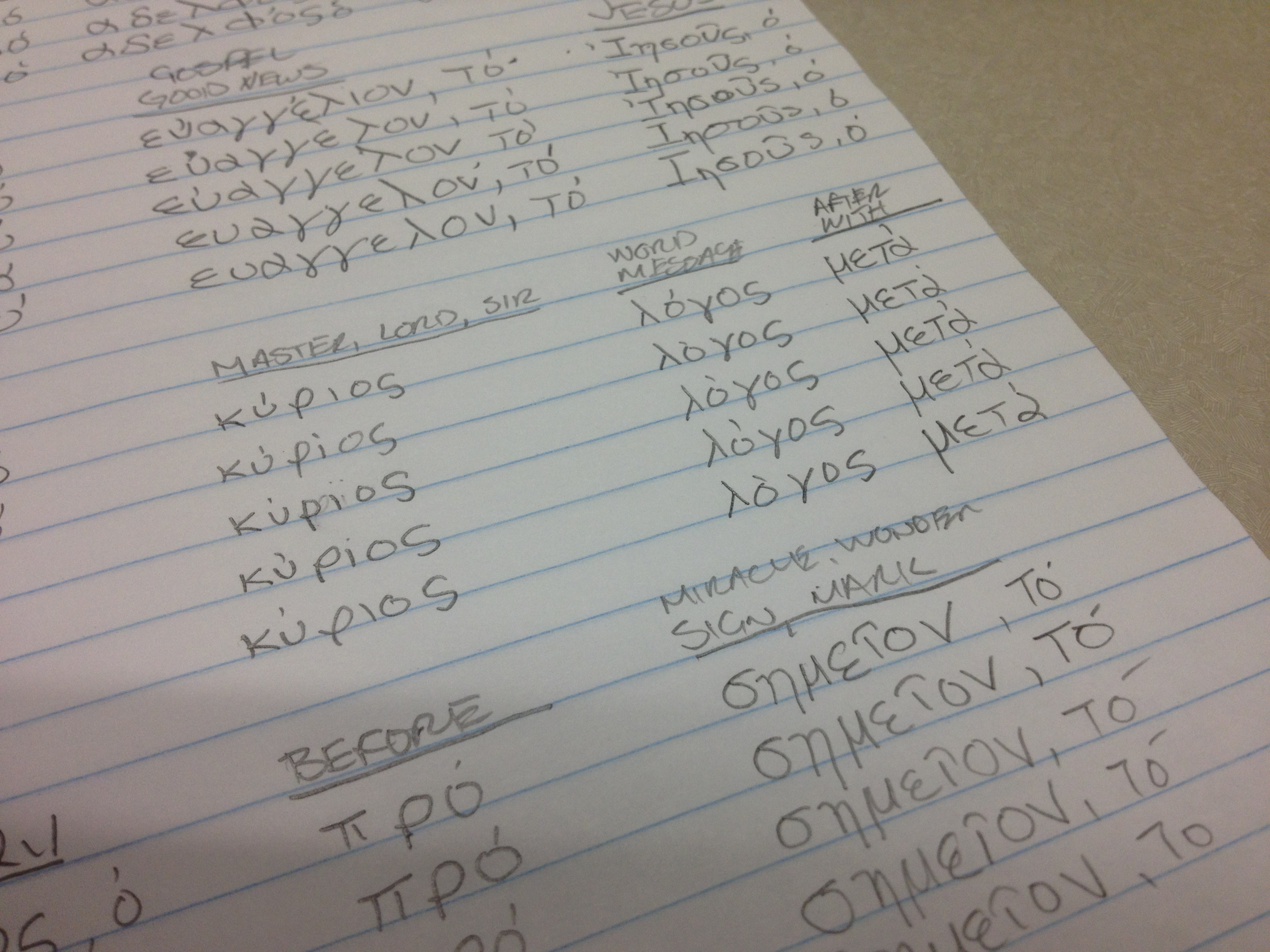
At the point which time as we know it began was the Word (λόγος in the greek) and the Word (λόγος) was there with God, and Word was (λόγος) in fact, God.

To is earth-shaking concept! It was very important to the greeks  Λόγος, was a very important concept in Hellenistic culture, as explained by many scholars (like this one). In a very dualistic culture John is laying it out up front that there is no separation between God and Christ. Ιn fact this λόγος the ultimate knowledge, is God. And oh by the way, God is Christ.

It is also a a very important concept today.  Here is a brief definition from the Dictionary of Biblical Languages With Semantic Domains;

3364 λόγος (logos), statement, that which is said, speech, the act. of speaking, gospel, the content of what is preached about Christ, treatise, systematic treatment of a subject, Word, Message, a title for Christ, reason, a cause for something.

The Almighty Maker of Heaven, and Earth is God and God is Christ. They are not separate.   He who made humanity from the dust of the earth and breathed life into us is the same loving God who sent Christ and created a way for redemption .

WOW! Rich stuff. Thank you Dr. Stevens for teaching Greek.

I am studying Greek this semester, and I pray the original language deepens my love for the scripture.

bible, Life, Prayer

Batman, Aurora, and Comfort

20120720-094017.jpg

Last night at the premiere of the new movie The Dark Knight Rises, in Aurora Colorado there was a terrible incident. Early reports indicate that someone fired multiple shots during a midnight screening if the film. There are several victims. Many people died during this tragic act.

I pray for all those impacted by the tragedy. Continue reading “Batman, Aurora, and Comfort”

Uncategorized

Review: Jesus Calling by Sara Young

I first learned about Jesus Calling by Sara Young when a KLOVE host read from it on air. Initially I had a good impression of it. But, I was not inclined to read it. Over the last few weeks I have heard a few people quote Jesus Calling. I have heard many people ravening about it. I even heard someone call it “A modern day My Utmost For His Higest” Then I saw that it was available as an iOS app.Here’s a link. So, I finally submitted, and have began reading it.

Continue reading “Review: Jesus Calling by Sara Young”